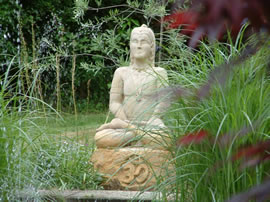
Shirley Hately
In October 2007 we had what was to be the final Trustees meeting with Swami Ji. He once more reiterated that he wanted to retire from actively running the Centre and again asked if I would take on the role. As things turned out, I was left without any choice. My love and devotion to Swami Ji was such that I could not walk away from his life’s work in creating such a beautiful Spiritual Centre for the continued practice of Classical Yoga. To say I was a little daunted by the prospect was an understatement, but we all know how Swami Ji could encourage us to do more than we felt able and helped us to rise to whatever challenge presented itself.
Eighteen months later we continue to flourish and thrive. We have a steady influx of new members and the gracious support of long standing members. During the past 18 months I have been completely overwhelmed by the love and support I have received. The other Trustees have given their all in every way possible. Many devoted members have offered their skills and support too, turning what could have potentially been a time of mourning and grief into a time of renewal and growth. I cannot thank you all enough. You know who you are and what you have contributed and I want everyone to know that I value each and every act of kindness and assistance you have given to me over the past months. I am encouraged to think that as time goes on I am developing my own unique relationship with everyone which continues to grow out of the legacy of such a Beautiful Soul none could replace or ever forget.
Without Swami Ji we would have no Centre and we shall always owe him an incredible debt for his love, dedication, self discipline and devotion to the Cause of Classical Yoga.
Please come when you can you will love the vibration and Peace. It is there to be shared.
With Love and Light
Your Spiritual Friend,
Shirley
The great teachers belong to all mankind. To accept one of them as one’s own and discard the rest as belonging to others is a sign of pettiness. Rama, Krishna, Christ, Mohammed, Nanak ….. they are for all people everywhere.
Love all religions and all nations. Recognise and accept all religions as paths leading humanity to the same destination. All of them teach love and compassion, humility and tolerance.
I bless all of you and ask you to promote love, sympathy and compassion towards all beings. God is present in every one of them and it is your duty to revere God in each of them.
There is only one caste, the caste of humanity.
There is only one religion, the religion of love.
There is only one language, the language of the heart.
There is only one God and He is omnipresent.
- Sai Baba
Published on
July 30, 2009 in
Recipes.
This recipe was provided by Vanessa Graham. It is the basis of the decorated cake that she made for Supriyā and family at the April satsang.
Ingredients: 12 servings
- 3/4 cup hot water
- 1/2 cup butter
- 1/2 cup white sugar
- 1/2 teaspoon ground nutmeg
- 1 teaspoon mixed spice
- 3/4 cup dried mixed fruit, chopped
- 1/2 teaspoon baking soda
- 2 cups self-rising flour
Note: You can vary the ingredients of the mixed fruit to your tastes. The fruit can be soaked in fruit juice for an hour before hand if required.
Method:
- Grease tin and line with greaseproof paper to come an inch above sides of tin. Brush paper with melted fat.
- Preheat oven to 375 degrees F (190 degrees C). Grease a 9×13 inch pan.
- In a saucepan, combine the water, butter, sugar, nutmeg, mixed spice and fruit. Stir over medium heat until the butter is melted and sugar is dissolved. Bring mixture to a boil, then simmer for 3 minutes. Remove from heat and cool slightly until lukewarm. Stir in baking soda.
- Sift flour into a large bowl and make a well in the centre. Pour the fruit mixture into the flour, and mix together until blended.
- Pour batter into prepared pan, smoothing surface with the back of a spoon. Bake in the preheated oven for 75 minutes, or until a toothpick inserted into the centre of the cake comes out clean. Allow to cool in the pan for 5 minutes, then turn out onto wire rack and cool completely.
Dear Kamlesh and friends of Patanjali Yoga Ashram,
I am deeply touched by the current Magazine and so pleased to know beloved Indarji’s devotees continue to keep up the good work.
I miss him very much, but hear his advice and chuckles which are always alive in my head and heart.
Many thanks and hope you are all well,
Blessings, Om Shanti,
Louisa Klein
From Elane Conway introducing herself by email before visiting the ashram for the first time:
I am a mature student in the third year of a religious studies degree course. I have a great love and fascination with the Hindu philosophical traditions, in particular the more traditional, classical schools and have massively enjoyed the ‘Hindu Religious Thought’ module I just completed at Kent University.
Although we have studied right through to the present day, I left my heart with Patanjali part way through the course and was just delighted while researching on the internet, to come across your website. I am not ‘a Hindu’, nor have I ever practiced any form of Hinduism, although I would love to see and be part of it. My immediate interest is in your library and the possibility of learning some basic Sanskrit, as I would like to do an MA in 2010.
I did a module last year entitled ‘Gurus and Disciples’ and as well as studying the traditional relationship, we also looked at new religious groups and I would just like to assure you that I am not researching you or your ashram. My intention is only to learn from you and your books. Please let me know if this is all ok and if there is a convenient time for me to come to Battle. I am very excited about it.
And her letter after her first visit to the ashram for April satsang:
Dear Shirley and all at the Patanjali Yoga Centre,
I wanted to write to thank you all for the wonderful day we spent together at the Havan Yajna, and for making me feel so welcome and comfortable in an atmosphere which was quite unfamiliar to me. It was just lovely to see the way each of you contributed to the day in your own individual and unique ways, and the opportunity to sit, Indian style, by the visiting Swami as he taught straight from the Bhagavad-Gita was an experience of great value to me.
I felt very shy and awkward approaching the ashram for the first time, and was almost tempted to steal off into the woods to spend the day with the trees rather than knock on the door. The grounds are so natural and peaceful, and the whole ashram is still saturated by the presence of the guru. His absence, and your own longing, was palpable as I sat with you all. My very sincere condolences.
The yajna was wonderful, having absorbed so much of its spirituality and philosophy at University and from books, seeing it actually ‘happen’ was truly a revelation. While the spiritual significance of ghee in Indian thought is highly important to me, feeling it in my fingers for the first time was something I just can’t describe. Did I really play a tiny part in sustaining the cosmic order of the universe? Perhaps, but if I did, it certainly wasn’t due to my mantra chanting skills. Sorry about that. Still, in spite of me, the resonance in the room created by the Aum sound was quite beautiful and strangely moving.
Of course the time with you was quite wonderful for me and I am so very grateful. From the ghee to the guru, I loved it all and am looking forward very much to coming back in May. I am also hoping to get a yoga class or two in on Monday nights before that.
Warm regards,
Elane Conway xox (Om)
Harry attends Jenny Newman’s yoga class in Suffolk and is a qualified homeopathic practitioner.
Homeopathy is an effective and safe form of healing which assists the natural tendency of the body to heal itself. It recognises that all of the symptoms of ill health are expressions of disharmony or dis-ease within the person and that it is the patient who needs treating, not the disease.
Homeopathy (from the Greek words meaning ‘similar suffering’) was developed by Samuel Hahnemann about 200 years ago. He realised, like Hippocrates 2000 years earlier, that there were two ways of treating ill health, the way off opposites and the way of similars. Insomnia for example treated by the way of opposites (conventional medicine or allopathy) is by giving a drug which brings about an artificial sleep. This often means giving large doses of drugs which can themselves cause side effects or addiction. The homeopathic way, the way of similars is to give the patient a very dilute dose of a substance such as coffee. This dilute dose, perhaps surprisingly, will enable the patient to sleep naturally while coffee in large doses will cause sleeplessness in a healthy person.
Thus the basic principle of Homeopathy is expressed as simila similibus curentor, or ‘like may be cured by like’.
The aims of homeopathy are curative; the remedies do not suppress your symptoms like conventional medicines, but instead will lead you to a stronger state of health than before. The remedies work by stimulating the bodies own energy system to bring about healing. This stimulating effect assists in clearing disease rather than suppressing it. The absence of any toxic ingredients make the remedies extremely safe to use and are particularly useful for babies, the elderly and infirm and during pregnancy and the menopause.
The remedies come from many different sources and most are derived from plants. The raw material is prepared in such a way that it can subsequently be diluted and shaken in a process called succussion. The dilution process can occur many times and the diluted remedies are described as being ‘potentised’, in recognition of the dynamic healing power they can stimulate.
Hahnemann ascribed healing to the restoration of the ‘Vital Force’ and this is observed during homeopathic practice when the patient feels improved in themselves, their energy increases and the diseased state is overcome. It is this Vital Force that contains all aspects of human expression, it is the manifestation of life energy and we shall look more closely at the Vital Force in the next article.
Real discrimination is to tell the original basic Truth from the every changing names and forms It assumes (Bk2v26), but how can we do this? We can develop our own discrimination faculty (viveka) which comes from our buddhi (intelligence) to determine what is beneficial or detrimental to our spiritual lives.
We live in a material world based on consumerism where we continually desire material goods. Desires can also cover material wealth and people, whereby when a desire is fulfilled it is replaced by another. There is a constant search for acquisition that can never be sated. The same has been happening for thousands of years and Patanjali highlights this in his sutra (Bk2v15) in that we need to become a person of discrimination (vivekinah).
He points out that desire and craving catch you in a web of pain and pleasure. Pleasure when your desire is satisfied but painful when it is not. Possessions can become very important whereby your identity can be formed by them i.e. your car, house, work status etc. There develops an anxiety over maintaining them and fear for their loss, these being painful experiences. Past pleasures can become painful when they renew cravings in the mind and a continuous circle of desiring develops. Note when a desire is not fulfilled and when someone else has the object of desire, how envy develops.
Our desires become painful (dukhair) because of our attachment to them and our fearing of losing them. We spend our lives swinging from the painful to the pleasurable (sukhair) and this creates imprints in our mind (samskaras) which never give us peace of mind. The same with the gunas, between the extremes tamas and rajas (lethargy-energetic) we need to look for the middle sattvic path, where we will not be disturbed by desires or cravings.
When man identifies with his body, mind and senses, he believes himself to be an isolated individual. Through ignorance he has lost sight of his true nature that his is Atman, the Spirit. He is searching in the wrong direction for lasting happiness, instead of always seeking it in outward gratification there needs to be a turning inwards. To dwell in the heart centre where the presence of God can be felt directly. Atman is motionless and actionless, it is the witness of everything. When resting in the Atman the personal senses can move among the sense objects but remain free from all actions. It is actionless in the midst of action, where one can be free from all desires. Our ego is the main obstacle to us experiencing the Atman but with the disciplines of discrimination and dispassion it can be realised
We can live in this world but not be a part of it, experiencing the material around us with gratitude but non-attachment (vairagya). Not to cling to objects or people for one’s own aggrandizement or sole use. Discrimination is needed where we stand back in our witness (drastuh) and observe these wants. Sharing and living for others reaps its own reward. Use your viveka to discriminate your thoughts and actions as to what is beneficial or not.
We do not need to renounce this world but to learn to live within it with discrimination. Family life is the ground for learning to develop spiritually. It provides many teaching opportunities whereby we can grow spiritually. Be part of the world but not of it. Whilst we are part of it, the mind needs to be steadied and not tossed by desires, not getting caught in the web of desires. Start to eliminate these distractions and they will no longer have a hold over you.
At the same time moving away from the personal to the universal viewpoint. To seek what is permanent and everlasting, which is ever present and ever available. That which never changes and is found in the depths of silence and stillness. To refocus the mind on the Truth (the Real). The pranava, the sacred Om (sounded A-U-M) can be used as a bridge from our physical world (sounding A) moving into the subtle world of the mind (sounding U) and then into the deeper depths of Being (sounding the nasal M, vibrating at the top of the nostrils). Sounding the AUM (keeping it short) creates a fine vibration which travels through these layers and beyond. It is a journey from the Unreal, our world of every changing names and forms, into the Real, the depths of Being.
Viveka was the theme for the April satsang where we seek to understand the ancient teachings. There is a different theme each month where the subject is open for discussion. Vanessa is available on vanessaegraham@aol.com to answer any queries.
Vanessa is being taught Sanskrit by Peter Harrison and she would like to share the knowledge she has gained so far. She is offering regular sessions before the Saturday lunch at each satsang. Everyone is welcome. The sessions started at the February 2008 satsang.
The focus will be the correct pronunciation of Sanskrit as each vowel and consonant is articulated from a different part of the throat, mouth or lips. Sounding is a very important part of Sanskrit, the sound carries it’s meaning, hence the need to correctly pronounce it. It is so much more than just a language; it can deepen your spiritual understanding. The Patanjali Sutras have been chosen to illustrate the points arising.
Vanessa wanted to read Sanskrit directly and this is what you can achieve yourself with regular practise. Simple homework will be provided to encourage progression.
Having just returned from the Karma Yoga weekend, I wanted immediately to write to say what a lovely time we had. This was the hottest and sunniest weekend of the year so far and even the trip down to Battle was delightful – rhododendrons everywhere.
The grass had grown with the rain followed by hot weather and Phil had to work very hard to get it all cut down as the lawn mower had a mechanical problem. He also tidied the gardens, cutting back shrubs and trees to keep our boundary clear. Such hard work for one man alone, but he did a heroic job.
The rest of us – Jenny and Bob, Carole, Monika, Lisa and myself were under the guidance of Geoffrey. During the weekend we managed to completely redecorate the bathroom, kitchen and Swami Ji’s bedroom. This was no mean feat and it was accomplished by hard work, dedication and lots of laughter. Without such dedicated people, our Centre would not exist and would certainly not be the beautiful place you see when you visit.
It will be interesting to see members’ reactions when they see all the transformative work that has been done. Please thank each of the individuals concerned when you next meet them.
Whilst we were employed inside, Geoffrey managed to oversee our work, try to repair the lawnmower, only to find the part had to be ordered, and do lots of work on the outside of the building. I am certain I speak for everyone on the weekend, there is a real sense of achievement when its all completed. Although, for myself, I do wonder how anyone could be so devoted for such a long time, as Geoffrey has been – 20 years of hard work on behalf of us all. So thank you, Geoffrey. You are a rare human being with great Soul and humility.
We have decided that this will be an annual event as we achieve so much, so please consider coming to help out next year. Although none can doubt the effect of “girl power” it would be wonderful to have more men volunteer their skills and strength too. Please think about any skills you have which you could offer to the Centre in the spirit of Karma Yoga. As Swami Ji always said – whatever we do in the name of Karma Yoga, such benefits will return to us many times over. And if the only skill you have is making money, we welcome that too…..
Shirley
– Programme Director
Open Day was a really lovely sunny day – as always. Many old friends came from far and near and it was
especially good to see Leonard and Jean and other long-standing members who made the long journey. Lynn comes from Somerset and Jenny from Suffolk, as well as those who travel from North London, the shortest journey being more than 2 hours long. Thank you all for your continued support.
We had a really special time together with Swami Nirliptananda Ji honouring us with his presence. It is wonderful that contact with this beautiful Soul continues. The day began with the usual yoga session which has now become part of our monthly Satsang, followed by the Sacred Havan Yajna led by Premanand. Carole was persuaded to give a demonstration of asanas which enthralled everyone. She has been dedicated to the Yogic path for many, many years and this was evidenced by her excellent postures executed with poise and grace. As Swami Ji always said, practice will make perfect, but it has to be done consistently for a long time to get any real benefits.

After a delicious lunch prepared by Rani, Swami Nirliptananda Ji gave us an inspiring talk. His message was how to find the Ocean of Happiness within. He commented that it is obscured by mental delusion of what is real. The Ocean of Happiness is within all the time, but the deluding factors are name and form. What is the reality of it all? For example, we see a piece of furniture, say a table. Do we see that only as a table, or as a piece of wood, or a tree? Are they one and the same? Rising above name and form is not always easy, but meditation upon what is real will help us. 
Phil read from his book about his travels with Swami Ji and sang the lovely “My Old Friend” which has become the unofficial monthly tribute to Swami Ji. The Satsang was closed with Avril leading the meditation and rounded off by tea and cakes brought by Jean and Jenny to celebrate Jean’s birthday. A really special day, full of loving vibrations and peace.